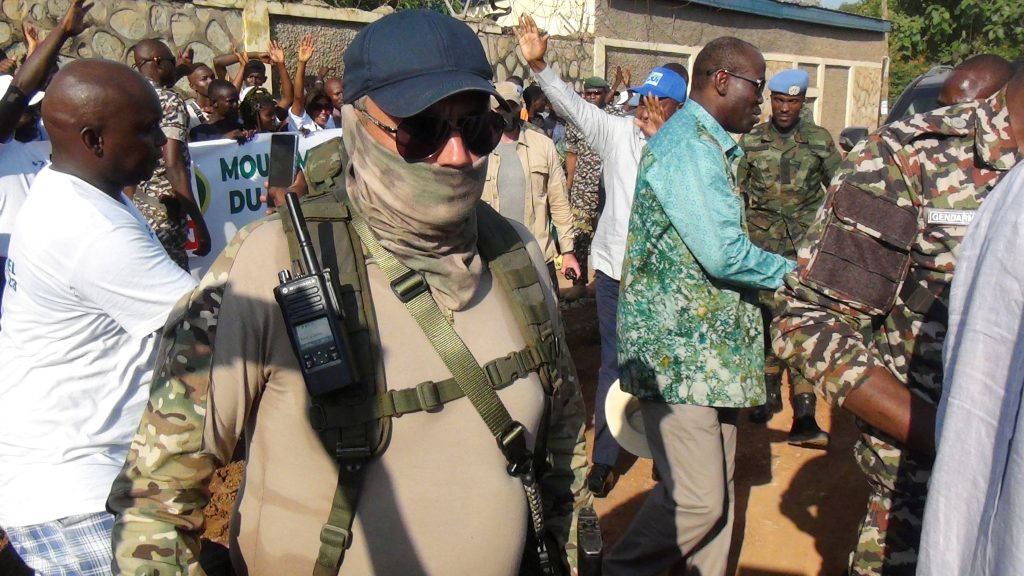
Introduction: Why Africa Matters for Russia
Russia's presence in Africa combines Cold War legacies, 21st-century economic opportunities, and an open rivalry with the West and China over political influence, resource access, and strategic positioning on the global board.
Unlike the Soviet Union, which bet on massive ideological projection, contemporary Russia operates with more limited resources and therefore selects power niches: security, energy, arms trade, mining access, and informational influence operations. The result is a presence less visible than China's or the West's, but highly concentrated at friction points where a few agreements can shift the internal balance of an African country.
This investigation follows three analytical axes: a basic quantitative snapshot, a map of the power dimensions Moscow deploys on the continent, and a timeline showing how, step by step, Russian influence has been reconfigured from the year 2000 to the mid-2020s.
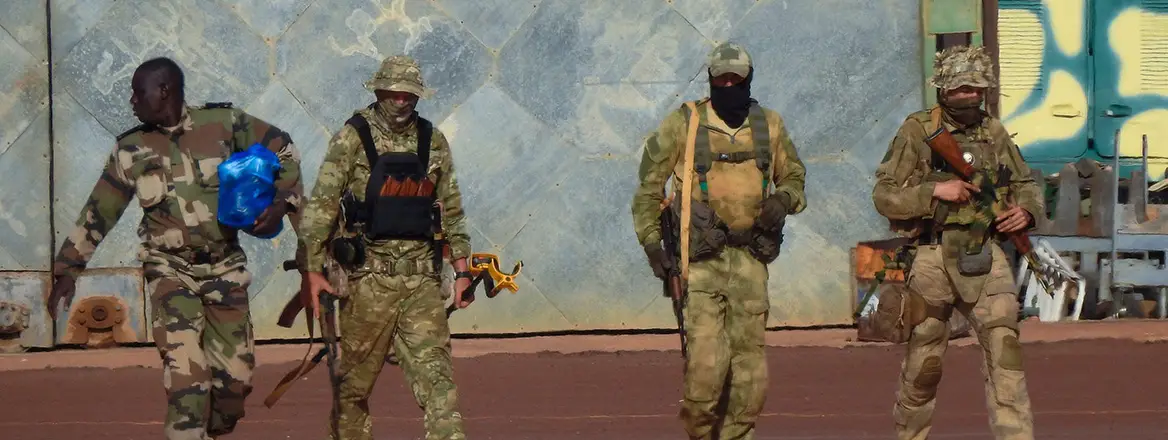
Wagner/Africa Corps personnel documented operating in the Sahel region alongside local armed forces
Key Statistics of the Russia–Africa Relationship
Bilateral Trade on the Rise
Although total trade between Russia and Africa remains modest compared to partners such as the European Union or China, the relative growth over the last decade is notable. Total exchange rose from figures around $10–12 billion in the mid-2010s to more than $24 billion in 2023, with double-digit growth year after year.
The structure of trade reveals the logic of power: Russia exports mainly cereals, fertilizers, hydrocarbons, industrial equipment, and above all weapons systems; in return, it imports raw materials, agricultural products, and manufactured goods.
Arms: The Most Visible Vector
Russia consolidated itself as one of the main suppliers of heavy armaments to the continent, at times accounting for around 40% of African imports of major weapons systems. This share has declined since the war in Ukraine, but Moscow's historical weight in this market remains considerable.
More than forty African countries maintain some form of military-technical cooperation with Russia, from helicopter contracts and air defense systems to maintenance programs and officer training at Russian academies.
Dependence on a Few Key Partners
Russian trade with Africa is highly concentrated: Egypt, Algeria, and a small group of North African countries absorb a disproportionate share of total exchange. Many sub-Saharan states maintain intense political relations with Moscow but with little commercial volume.
This asymmetry explains why Africa's global economic impact on the Russian economy is limited, while the political and symbolic impact — votes in international forums, diplomatic support, access to bases and resources — is far more significant for the Kremlin.
Selected Indicators
| Indicator | Approximate Period | Order of Magnitude | Geopolitical Reading |
|---|---|---|---|
| Russia–Africa Trade | 2013 → 2023 | From ~$15B to ~$24–25B | Rapid growth but still far below official targets and other partners. |
| Annual increase 2023 | 2022 → 2023 | Around +35–40% | Acceleration of Russia's pivot to Africa following Western sanctions. |
| Share of African arms imports | Last decade | ~40% in some periods; recent downward trend | Military influence remains the central pillar, though increasingly competing with China. |
| African states with military agreements with Russia | 2020s | Over 40 states | Broad defense-link network, but with highly uneven levels of intensity. |
| Russia–Africa Summits (heads of state) | 2019 vs. 2023 | From 40+ to around 17 | Signal that the Ukraine war and Western pressure have eroded part of Moscow's appeal. |
The Four Dimensions of Russian Influence
Russia's strategy in Africa is two-headed: it combines classic state instruments — embassies, ministries, state enterprises — with opaque or hybrid tools — private security groups, disinformation campaigns, local intermediary networks — that allow Moscow to project power at a relatively low cost and with greater political deniability.
1. Security and Military Presence
The security vector is the most disruptive. Bilateral defense agreements, arms sales, and the deployment of instructors or security contractors allow Russia to enter niches where the West is perceived as conditional or slow to act, especially in fragile states hit by insurgencies and coups.
This presence usually comes with mining concessions, port or airfield access privileges, and direct influence over elite units that, in practice, become guarantors of the local regime.
2. Political and Diplomatic Power
Moscow exploits its Soviet legacy as an ally of anti-colonial movements to present itself as an alternative partner against former European powers. The message is simple: Russia offers political support, weapons, and an anti-"neocolonialism" discourse without demanding democratic reforms or transparency.
In return, the Kremlin obtains something highly valuable: votes, abstentions, and strategic silences at the United Nations and other forums where each African state carries an equally valid vote.
3. Economic Exchange and Resources
Compared to the European Union, the United States, or China, Russia's economic weight in Africa is limited, but well aligned with Russian structural strengths: energy, agriculture, and defense. This combination makes it possible to create dependency cycles — in grain or fertilizers — that become political levers in moments of crisis.
In terms of resources, collaboration often crystallizes in mining projects, especially in gold, diamonds, uranium, and other strategic materials. These agreements, frequently opaque, mix Russian state interests with semi-private business networks.
4. Information, Narrative, and Culture
The battle for the narrative is another key front. Affiliated media, social media campaigns, and the use of colonial languages (French and English) amplify messages favorable to Moscow: criticism of Western double standards, emphasis on sovereignty, and denunciation of European colonial history.
In parallel, university scholarships, technical training programs, and cultural cooperation replicate, in reduced format, the old Soviet policies of attracting African elites to Russian universities, creating human capital with lasting personal ties.
Timeline: From Soviet Heritage to the Summit Cycle
Russian influence in Africa did not emerge from zero in the 21st century: it draws on the political, military, and educational investment the Soviet Union made during the Cold War. However, the current cycle has its own dynamics, marked by the disappearance of the USSR, Russia's re-emergence as a proactive actor under Vladimir Putin's leadership, and the systemic impact of the war in Ukraine.
The USSR invests in liberation movements, affiliated parties, and African socialist governments, providing military training, university scholarships, and technical assistance. Personal ties and networks of cadres are created that will survive the fall of the Soviet bloc.
The Soviet collapse causes an abrupt withdrawal: bases are closed, cooperation programs are reduced, and Moscow loses its capacity to project power. The space is gradually occupied by Western actors, international financial institutions, and, later, by China.
With Putin's internal consolidation, Russia begins to gradually rebuild its African presence: it forgives part of inherited debt, signs new military agreements, and reactivates contacts with old allies — though without a major economic deployment.
The annexation of Crimea and the first major Western sanctions push Moscow to seek partners outside the Euro-Atlantic axis. Africa, alongside Asia and the Middle East, becomes one of the natural destinations of this diplomatic and commercial pivot.
Private security groups linked to Russian interests begin operating in countries such as Sudan and the Central African Republic. Their function goes beyond security: they protect mining interests, advise governments, and participate in internal influence campaigns. The Wagner Group becomes Moscow's deniable instrument of choice across the continent.
The Sochi summit brings together the vast majority of African heads of state and symbolizes Moscow's intent to institutionalize its relationship with the continent. Ambitious objectives to double trade are set, and memoranda of understanding in defense, energy, and mining multiply.
The health crisis limits face-to-face contacts, but also reinforces the need for security support and basic supplies. Russia takes advantage of the moment to consolidate its presence in countries with internal conflicts, offering support outside strict Western conditionalities.
Russia's large-scale invasion of Ukraine reconfigures African policy toward Moscow. Many governments opt for formal neutrality at the United Nations; others align with Moscow or the West. For the Kremlin, each African abstention is a diplomatic success against the isolation narrative.
The second Russia–Africa summit manages to gather nearly fifty delegations, but with far fewer heads of state present than in 2019. The context of war and growing Chinese and Turkish competition limit the event's luster, though Moscow maintains its narrative as a reliable partner in energy and security.
The prolongation of the Ukraine war reduces Russia's capacity to supply armaments abroad and opens space for other actors, especially China, to gain market share in African arms. Even so, Moscow attempts to maintain its positions by combining security agreements, grain discounts, and anti-Western rhetoric. Wagner is formally rebranded as Africa Corps under direct Ministry of Defense control.
"Africa is not the center of Russia's global strategy, but it is a laboratory where Moscow tests how to project power with limited resources in an increasingly multipolar environment."
ODINT on the Ground: The Rwanda Case
Russia's African footprint is not limited to security contractors and mineral extraction. ODINT's investigation into Rwanda — published in February 2026 — revealed a parallel vector of Russian influence operating through civilian infrastructure and diplomatic networks. At its center: a 2018 intergovernmental agreement between Kigali and Moscow on the peaceful use of nuclear energy, which laid the groundwork for Rosatom to build a Nuclear Science and Technology Centre (CNST) in Rwanda — a 10 MW research reactor complex comprising six facilities, from a radiation science lab to an education and training center. By the time Rwanda's Parliament ratified the agreement in 2024, the program had become binding law. Rwandan personnel were already being trained in Russia. Russian engineers were already deployed to Kigali.
The investigation also documented a direct personal connection: Christine Nkulikiyinka, Rwanda's current Minister of Public Service and Labour — the official overseeing the government's blacklist architecture — previously served as Rwanda's Ambassador to Russia from 2011 to 2013, a period that aligned with the early diplomatic groundwork for the nuclear cooperation framework. The ministry she now leads, MIFOTRA, manages a publicly exposed database of 689 dismissed public servants with full PII — infrastructure ODINT independently located and documented.
The pattern is consistent with how Russian influence operates across the continent: a diplomatic entry point, a high-visibility civilian project (in this case nuclear energy), and a senior official whose network traces directly to Moscow. Rwanda is not an outlier — it is a template. Read the full Rwanda ODINT investigation →
What ODINT Investigations Have Uncovered in Africa
The following sites represent documented operational nodes where Wagner Group and its successor Africa Corps have been geolocated, confirmed, or corroborated through open-source intelligence. Each location reflects a specific function within Russia's African architecture: security extraction, logistical projection, or resource control.
18.1226 E
Berengo Camp — 4°02'45.9"N 18°06'58.4"E · Former Bokassa palace complex, now Wagner/Africa Corps primary command facility in CAR
20.7933 E
Ndassima Gold Mine — 6°09'34"N 20°47'36"E · CAR's largest gold deposit operating under Wagner-linked concession
20.6670 E
Bambari — 5°45'40"N 20°40'01"E · Wagner operations staging zone in central CAR, counter-insurgency and diamond corridor
1.2970 W
Gossi — 15°49'22"N 1°17'49"W · Former French Barkhane outpost seized by Africa Corps in 2022, confirmed forward position
3.0026 W
Timbuktu — 16°46'00"N 3°00'09"W · Africa Corps airport base controlling the trans-Saharan corridor
0.0500 W
Gao — 16°16'00"N 0°03'00"W · Key Africa Corps northern base, former MINUSMA/Barkhane shared facilities
2.4000 E
Menaka — 15°55'00"N 2°24'00"E · Africa Corps forward position at the three-border zone (Mali-Niger-Burkina Faso)
4.1000 W
Sévaré — 14°32'00"N 4°06'00"W · Operational hub with helicopter operations, primary northward resupply point
7.9333 W
Bamako Airport Area — 12°32'00"N 7°56'00"W · Primary Russian logistics entry point, Modibo Keïta International Airport zone
1.4078 E
Kidal — 18°26'28"N 1°24'28"E · Recaptured with Wagner support in 2023, active northern Mali presence
23.2667 E
Al-Khadim Airbase — 32°09'00"N 23°16'00"E · Primary Russian/Wagner logistics hub in Cyrenaica, Libya
16.0000 E
Al-Jufrah Airbase — 29°12'00"N 16°00'00"E · Forward base enabling Russian/Wagner projection toward Chad, Sudan, and Niger
1.3000 W
Loumbila — 12°31'08"N 1°18'00"W · Africa Corps base in Burkina Faso, established post-French expulsion 2023
21.9833 E
Bria — 6°32'00"N 21°59'00"E · Wagner-controlled diamond extraction zone in eastern CAR, DRC-border supply chains
22.8333 E
Bangassou — 4°44'00"N 22°50'00"E · CAR frontier zone near DRC border securing diamond extraction and transport corridors
16.5833 E
Sirte Area — 31°12'00"N 16°35'00"E · Wagner-held LNA front line, Mediterranean coastal infrastructure and shipping lane leverage
40.5167 E
Pemba — 12°58'00"S 40°31'00"E · Cabo Delgado capital, Russian PMC deployment zone targeting strategic LNG corridor
2.1167 E
Niamey Airbase Area — 13°31'00"N 2°07'00"E · Diori Hamani International Airport zone, Africa Corps replacing expelled U.S. forces post-2023 coup
35.0000 E
Abidiya Gold Mine Area — 18°00'00"N 35°00'00"E · Longest-running Wagner mineral extraction scheme in Africa, active since 2017
ODINT Africa Operations Map
All 19 documented sites are mapped below. Each marker represents a confirmed or corroborated Wagner/Africa Corps operational location, derived from open-source intelligence, satellite imagery analysis, and cross-referenced field reporting.
Investigator's Note
This report is based entirely on open-source intelligence (OSINT). No classified information was accessed. No confidential sources were used. Everything documented here — coordinates, operational patterns, resource extraction mechanisms, and political dynamics — is derived from publicly verifiable reporting, satellite imagery, field journalism, and government records.
ODINT's passive network analysis across African countries has tracked the evolution of Russian-linked operational infrastructure through systematic cross-referencing of satellite imagery, field reporting, infrastructure fingerprinting, and open-source corroboration. The 19 sites documented in this report emerged from that analysis as consistently verified operational nodes within the broader Russian projection architecture across the continent.
The statistical figures cited in this report reflect approximate orders of magnitude and trend directions drawn from public data. The goal is interpretive accuracy, not false precision.